Selling · · 6 min read
How Long Does It Take to Sell a Home in North Phoenix? What Sellers Should Know

If you're thinking about selling your home in North Phoenix, one of your first questions is probably, "How long is this going to take?"
It's a fair question, especially if you're coordinating a move, buying another home, or trying to make financial decisions around your sale.
The short answer? It depends.
I know, not exactly the satisfying answer you were hoping for. But understanding why some homes sell quickly while others sit on the market can help you make better decisions before that For Sale sign ever goes up.
And in today's North Phoenix market, those decisions matter.
How long are homes actually taking to sell in North Phoenix?
According to Realtor.com's September 2026 market data, the median time on market in North Phoenix was 66 days.
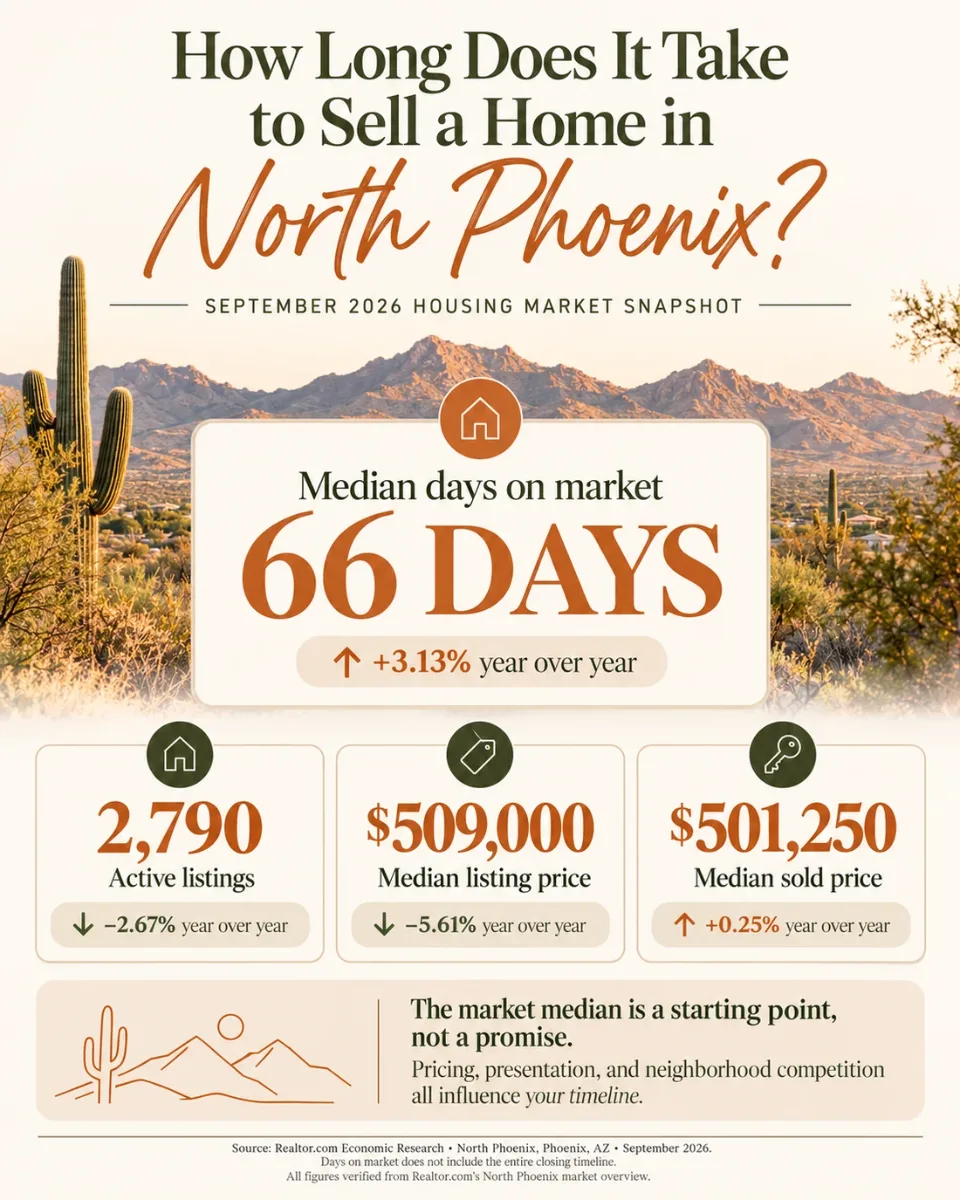
That's a useful starting point, but it doesn't mean your home will take exactly 66 days to find a buyer.
A well-positioned home may attract an offer relatively quickly. Another home just a few streets away might sit considerably longer.
The difference can come down to pricing, condition, location, competing listings, and what buyers are looking for at that particular moment.
There's also an important distinction between finding a buyer and completing the sale. Once a home goes under contract, there's still the inspection period, appraisal when applicable, financing, and closing process to navigate.
If you're planning your next move, we need to account for the entire timeline, not just the days your home spends listed.
Your home's value isn't necessarily the number you need from the sale
This is probably one of the most important conversations I can have with a seller.
You might have a specific number in mind because of what you paid, what you've invested in improvements, or how much you need for your next home.
And I understand that. Selling a home is personal, and the financial implications are very real.
But the market doesn't determine value based on what we need to walk away with.
Market value is ultimately shaped by what buyers are willing to pay for a property in the current market.
That doesn't mean your goals don't matter. They absolutely do. It means we need to understand how those goals line up with the market before making decisions.
The housing market of 2021 isn't the housing market of 2026. Pricing based on what a neighbor received several years ago, without considering current conditions, can create unrealistic expectations.
My job isn't to tell you the number you want to hear. It's to help you understand the numbers, what supports them, and what your options look like.
Why pricing too high can cost you valuable time
Imagine you're standing in a store looking at two chocolate bars.
They're the same brand, same size, same ingredients. One costs 50 cents more.
Which one are you buying?
Real estate is obviously more complicated than chocolate, but buyers make comparisons in much the same way.
If two homes offer similar layouts, conditions, locations, and features, but one is noticeably more expensive, buyers are going to want to know why.
And if they can't see the additional value, they may move on to the other home.
This is why I believe pricing correctly from the beginning is so important.
An overpriced home may receive fewer showings, fewer offers, and eventually require a price adjustment to attract renewed interest.
Price reductions aren't inherently bad. Sometimes they're the right response to market feedback. But I'd much rather begin with a thoughtful pricing strategy than spend weeks trying to correct an avoidable problem.
I've been on the other side of this conversation
Back in 2015, when my family was trying to sell our own home, we priced it too high.
And we got zero offers.
I remember how frustrating that felt. We loved our home. We knew what made it special, and it was difficult to understand why buyers weren't seeing what we saw.
But that's the thing about selling a home.
As homeowners, we see the memories, the work we've put into the property, and all the little details that made it ours.
Buyers are looking through a different lens.
They're thinking about their budget, the condition of the property, what they'll need to change, and how it compares with everything else they've toured.
The seller is looking at their home. The buyer is looking at their options.
Neither perspective is wrong, but understanding that difference can change how we approach a sale.
That experience has stayed with me, and it's one reason I believe in having honest pricing conversations before a home goes on the market.
North Phoenix sellers have another factor to consider: new construction
One of the things that makes North Phoenix interesting is how much the area continues to develop.
Between new communities, expanding infrastructure, and the growth surrounding the TSMC semiconductor campus, the northern part of the Valley is changing.
The Halo Vista development near TSMC is one example of the scale of investment happening in the area.
But for homeowners selling an existing property, development also means paying attention to competition.
A buyer looking at your home may also be considering a brand-new property nearby.
And builders sometimes offer incentives, including financing assistance or closing-cost contributions, that can make a new home particularly attractive.
That doesn't mean existing homes can't compete.
Established neighborhoods, mature landscaping, completed backyards, desirable lots, and homes with improvements already in place can offer advantages of their own.
The key is understanding what buyers are comparing and positioning your property accordingly.
Sometimes that means emphasizing features a new build doesn't include. Other times, it might mean considering a seller concession or another incentive that makes the overall purchase more appealing.
We don't necessarily need to compete on price alone. We need to compete on value.
What happens if your home isn't getting much interest?
First, we don't panic.
But we don't ignore the information we're getting, either.
If a home has been listed for several weeks without meaningful activity, I want to look at the entire picture.
Are buyers seeing the listing online but not scheduling showings?
Are they touring the property but choosing something else?
Are similar homes going under contract while ours isn't?
Those situations may point to different issues.
We need to evaluate the price, condition, presentation, marketing, showing availability, and competition.
Sometimes a change in photography or presentation helps. Sometimes we need to address a condition issue or reconsider the incentives we're offering.
And yes, sometimes the answer is a price correction.
Nobody loves that conversation, myself included.
But avoiding an uncomfortable conversation doesn't help a seller reach their goal. I'd rather discuss what's happening, explain the options, and make an informed decision together.
So, how can you help your North Phoenix home sell?
You can't control mortgage rates, the number of competing listings, or every buyer's personal preferences.
But there are things you can control.
You can prepare your home so buyers can see its potential without being distracted by unnecessary repairs or clutter.
You can make it reasonably accessible for showings.
You can understand your competition and choose a listing price supported by current market evidence.
And you can work with an agent who pays attention to the response your home is getting and communicates with you throughout the process.
Selling successfully doesn't always mean selling in the fewest possible days. It means making decisions that support your financial goals, timeline, and circumstances.
My approach: realistic expectations, informed decisions
You can probably find an agent willing to list your home at whatever price you ask, without much discussion.
That's not how I work.
If I'm representing you, I want you to understand the reasoning behind our strategy, the current competition, and the potential consequences of each decision.
That doesn't mean I expect you to agree with every recommendation. It means I believe you deserve the information to make those decisions confidently.
I'm here to advocate for you, communicate clearly, and help you navigate the process—not simply put a sign in the yard and hope for the best.
Thinking about selling your home in North Phoenix?
Before deciding when to list, it's worth understanding what homes like yours are actually selling for, how long they're taking, and what buyers will be comparing them against.
Every neighborhood and every property is different, and broad market averages only tell part of the story.
If you're considering selling in North Phoenix, Norterra, North Gateway, Anthem, or the surrounding North Valley, I'd be happy to help you look at your options.
You don't have to be ready to list tomorrow to start the conversation.